Search here
 Log In
Standing Out in a Crowded Recruitment Marketplace Old War (of Talent) - New Rules
During 25 years of my career of Human resource Management I have observed that Top Brands even Fortune 500 ones struggle in Pakistan when it comes to ‘Employer Branding’. Amongst other factors the major one is, misperception amongst HR practitioners how to handle Employer Branding. A carefully crafted EB strategy will not only result in attracting top end talent but also reduced payroll and recruitment cost.
Companies are facing problems concerning the attraction and retention of talented employees, due to the shortage of individuals with competence. Employer Branding is a relatively new concept that can function as an instrument for firms to position themselves as an employer, in order to attract and retain wanted employees. In a recent survey 63% by Linkedin 63% of CEOs described that attracting talented people for their companies was the No 1 Challenge for them.
The brand is considered one of the most important and valuable assets of a company. To most people a brand is directly connected to the company name, the products, services and the specific logotype. However, branding can also be used as a part of Human Resource Management (HRM) in order to attract new employees and to retain already employed members of the firm (Kunerth & Mosley, 2011). The “war for talent” (Beechler & Woodward, 2009; Chambers et al., 1998); Elving et al., 2013; Girard & Fallery, 2010) and the globalization of the job market have motivated many companies to use marketing techniques in the recruitment process. The idea of applying marketing techniques to people management was first discussed in 1996 by Ambler and Barrow who used the term employer brand to refer to “the package of functional, economic and psychological benefits provided by employment, and identified with the employing company” (Ambler & Barrow, 1996). Employer branding includes communication activities to both external and internal audiences regarding the company’s offer that would make it distinctive among its competitors.
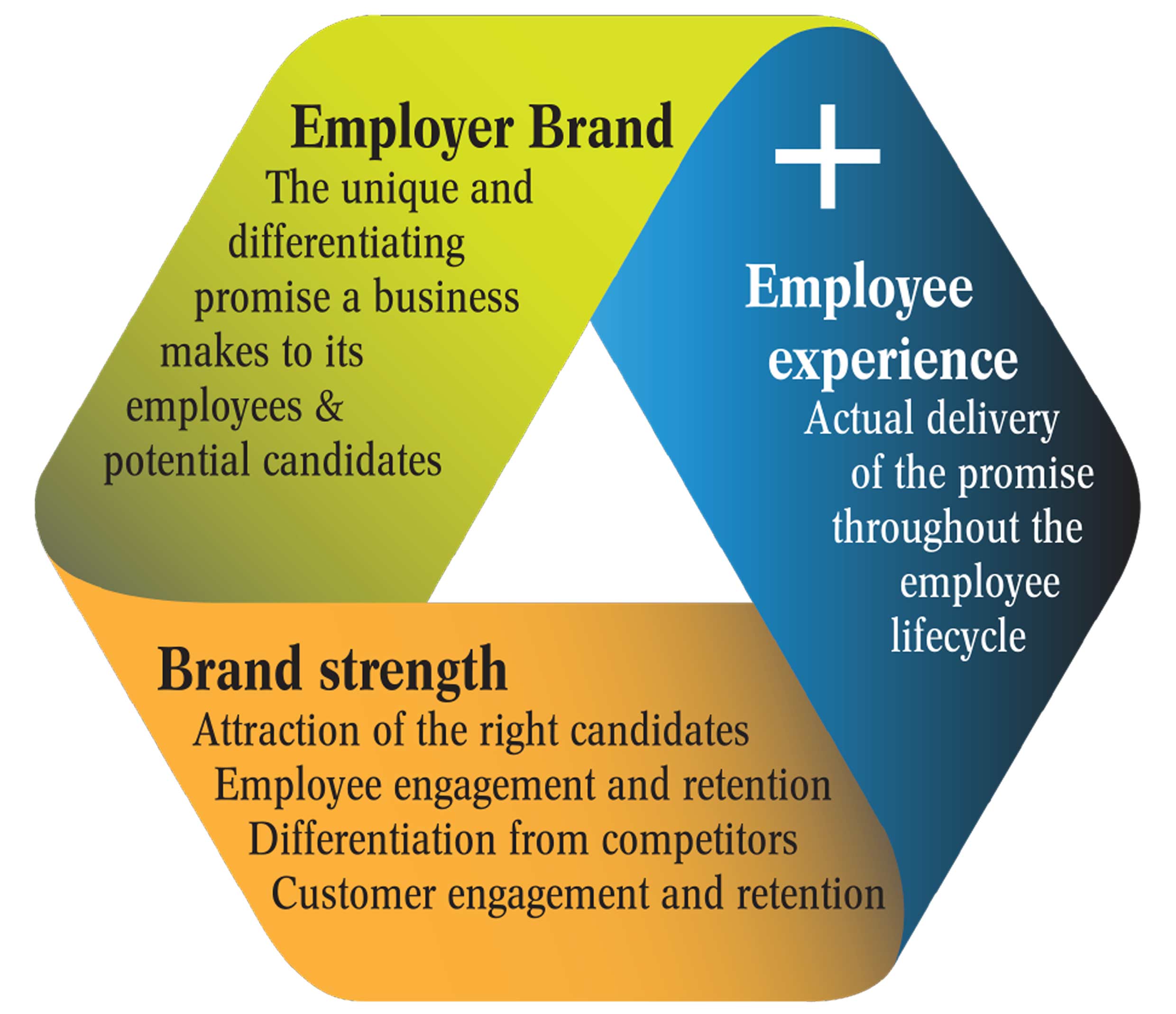
So what is an Employer Brand. It’s a promise of consistency and credibility to employees. It’s a story of YOU. An employer brand is what your talent experiences, thinks, feels and shares about you as a place to work. It is essentially experiences of employees about their employer. You will agree that it is too important a mater to be left for HR folks only. Your employer brand promise articulates your identity as an employer; showcases how you are unique; and inspires action.
Many of the old tools and strategies for building an authentic, globally relevant employer brand have been discarded, and new ones are taking over. Both the challenges and opportunities have grown almost in tandem, and it’s all happening at break-neck speed. One thing is clear: employer branding has changed, dramatically. So, if you are wondering if there’s a better, clearer way to lead your organization and practice through this change, this guide is for you.

Authenticity
A couple of years ago, marketers were busy designing nice corporate videos, telling the world how great their company was and how fantastic it was to work there. This approach has had its time. People are starting to build their own picture to understand what companies are really about instead of just accepting who they say they are.
Candidates come better prepared and knowing much more about your company than ever before. They’re not just looking at your website! You’re still the owner of the employer brand, but it is shifting towards what other people say about you—not only what you say about yourself.
Demonstrate
An employer brand must be accessible. Build a video channel that delivers what we call ‘corporate insights’. You would want to deliver a consistent employer brand experience through all major touch points like career websites, YouTube channel and Instagram account. By posting historical pictures from your Company events on Instagram you can show (rather than just talk about) your company’s history.
Build relationships by being useful
Candidates look around for employers. They do their research.
To connect with them, businesses must be present in the right places. But, more than this, they must demonstrate why their employer brand is different, relevant and useful.
Start by focusing on what candidates need and want from you— it’s not just about giving them a job. Be helpful in people’s job search and in the development of their careers. Be responsive and look to the bigger, longer-term picture when building connections with potential employees.
Content & conversation
You have to know what people are really lookingfor besides basic company information. What isthe audience interested in? Employer branding is not only about communicating how great we are and how great it is working for us, but also about providing the candidate market with information they really need.
Social media is a tool to have a conversation, to talk with candidates, to understand how they think and to provide information. With this information you can start to build a conversation, build engagement and a relationship.
Engagement
There are a lot of the ways to get information out there about your company, but it really depends on talking to people about things that interest them. It can go as far as to include customers and clients talking about how your company helped them with their business— that’s of interest to candidates who are thinking about a career with you.
Candidate perspective
Do your best to understand what kind of information candidates really need. What are their pain points? What is the buying process for candidates? First, understand what you can do for them. Then, be mindful that there’s a lead-nurturing process to consider, just as there is in any buying decision.
Employee trust
People often get tripped up on the need for a watertight social media policy, and they’ll run into internal concerns that question how much the company should embrace social media because what happens if people misuse it? People really get stuck on having a strict or a rigorous policy when it’s actually the best companies that do (almost) the opposite. Having a high level of trust on this shows you trust your employees more generally, and that speaks to your culture.
Transparency & authenticity
You have to be transparent. As a big company it is easy to look like a big corporate machine and I think one of the things that we’ve really tried to do is make things more personal and human. Your campaign is basically testimonials from your employees about what your Company means to them. It’s more than just a day in the life of. I think it’s really what the Company means to them. This is one of the ways we can set ourselves apart and tell a true and honest story about workplace and not give false expectations. Recruiting people to be your brand ambassadors can be one way to manage this proactively and have structure.
Messaging approach
There are two prongs to brand messaging and talent acquisition. There is the internal communications plan—you need that foundation where everyone’s on the same page. This is how all of HR is aligned, and it’s how you reach out to candidates.
The second prong is the 50-thousand-foot view of brand messaging, which is your external marketing plan; the ‘one’ global brand that works to get your name out there.
Understand to be understood
A lot of companies cut right to the tactics without first really understanding how to be true and authentic. Getting this right is a huge differentiator; it’s what makes companies either ‘good’ or ‘great’.
When you think of the marketing tactics, know what the brand attributes are that you’re marketing first. This is your employee culture. The ones who get this right are really clear on what their culture is and what it isn’t. Every brand has amazing things to say to their market, but the story you’re telling to help people understand who you are must be believable.
Perception is reality
You have to have a plan. You really can’t let the public drive their perception of you entirely because perception is reality. If they’re the only ones out there talking about your company then that’s what people are going to believe.
So your ‘fans’ own your brand but you can’t give it over to them. You have to really drive it with some of your own content. And, you have to walk the talk. If you’re saying externally what your company is like, what it’s all about, why it’s so great, you have to make sure that your own employees believe that and experience that.
CONCLUSION
Employer Branding has moved from a focused concept to something that encompasses the entire organization. It is no longer the hierarchy, the leadership team, nor even the HR or Marketing teams that can claim to own or control the brand going forward. Branding is now crowdsourced and often on a global scale with local influence.
Employer brands are no longer only about the present embodiment of any one particular business, they are a continuum of voices from past, present and future employees who have seen things from the inside.
The employer brand has become fluid, responsive and an ever changing conversation between organizations, employees, candidates and the media. The new age of employer branding has created additional challenges and opportunities for HR and Marketing staff, as well as for leadership teams that want and need the best talent for their businesses. By understanding the current environment and trends in employer branding, HR, Marketing and leadership teams can learn to adapt their strategies to influence rather than control, and to guiderather than dictate.
If evolution is the only successful strategy, Employer Branding will continue to evolve, and it’s only just beginning.
FYI
Less than half (46%) employees today can assert that they have felt committed, fulfilled (28%) or excited (26%) about work in the last month.
(Kelton 2013)