

 Search here
 Log In


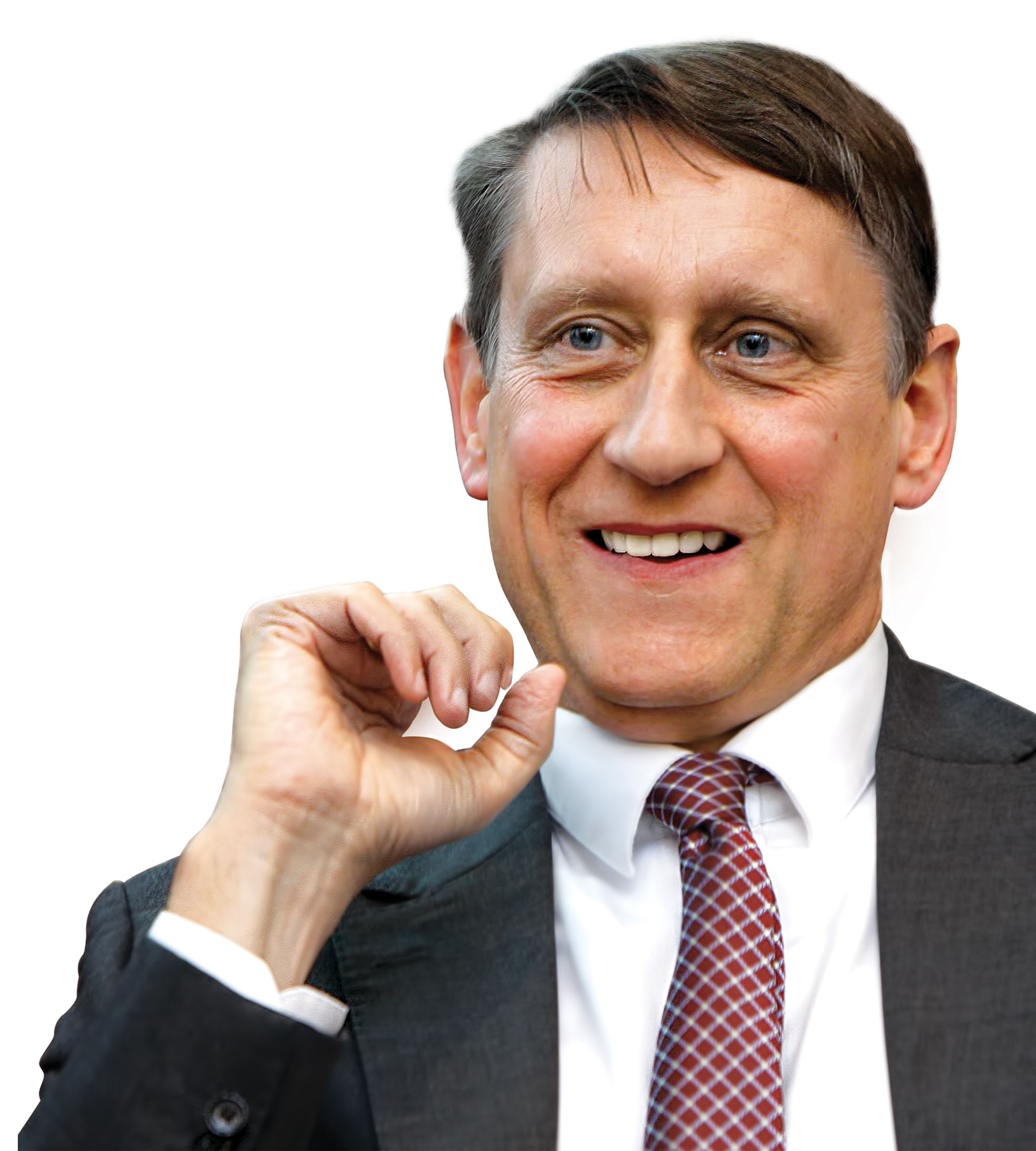
The Ambassador of Federal Republic of Germany in Pakistan
Blurb:
The geographical position of Pakistan bears an immense potential. You only have to look at a map to see the geopolitical importance of Pakistan. It has the potential to connect different parts of the world and be a gateway to Central Asia, India, China and thereby half the population of the planet.
Evolve: Currently Germany is the largest economy in the European Union with GDP of roughly three trillion USD. How Germany achieved this?
Dr Cyrill Nunn: I would name three important factors. The first and foremost is European Union. The regional integration of former enemies is the true miracle in Europe after World War II. It brought peace and stability to a troubled region. It all started with economic integration which brought economic growth. Everyone benefited from that process, including Germany. Today we are in an “ever closer union” and “united in diversity” as the motto of the European Union says.
Quality and sustainability are important to us. “Made in Germany” became a label known for quality around the world. When I talk to people in Pakistan and other countries, I understand that people appreciate quality and long-term thinking.
McKinsey did a study on global economic networks and how much different countries are integrated into the global economy and how it benefits countries. They measured import/export flows and data streams of countries around the world. The results showed that Germany is the most connected and economical integrated country in the world. Germany and its businesses benefit from a peaceful, open and rules-based world and economic order.
Evolve: How do you see Pakistan as a country and how would you compare Pakistan with other countries where you have worked?
Dr Cyrill Nunn: The geographical position of Pakistan bears an immense potential. You only have to look at a map to see the geopolitical importance of Pakistan. It has the potential to connect different parts of the world and be a gateway to Central Asia, India, China and thereby half the population of the planet. The other important potential of Pakistan is its youth. Its young population gives Pakistan the opportunity to become a dynamic society with a vibrant economy and new ideas. We are trying to support Pakistan in its efforts to unlock that potential and make it work for the benefit of all people in Pakistan.
As every country is unique, it is difficult to compare Pakistan to other countries I have worked in. In the last 2.5 years I have traveled all over Pakistan and talked to people from different parts of society. I discovered a fascinating country with beautiful landscapes. And I have met very interesting people with a diverse and rich culture.
Evolve: On one hand, we see German firms that are world leaders in employing renewable energy and, on the other hand, we have Pakistani firms facing acute energy shortage. How Germany can play its role in facilitating Pakistan to come out of this crisis?
Dr Cyrill Nunn: The German government is supporting Pakistani economy through various projects, such as a multi-year program being implemented by GIZ in Punjab which aims at enhancing energy savings and efficiency in the textile sector.
Furthermore, during the visit of Prime Minister Nawaz Sharif to Germany in November last year, Pakistan and Germany have decided to establish a Pakistan-German Renewable Energy Forum. It will provide advisory capacities in all field of renewable energy, e.g. promote practical application of technology as well as education, training, consultation, information and documentation. It will be coordinative hub between private and public sector institutions.
In the meantime, in order to cope with the power outages, German companies, active in Pakistan, are endeavoring to revert to self-produced renewable energy, for example, through high-technology solar installations or small-wind solutions and by increasing their overall energy efficiency.
In recent visit of Germany, Ms Merkel told Pakistan’s Prime Minister that Germany’s state development bank was already involved in projects in Pakistan, including hydropower plants, but added that the security situation was sometimes a deterrent
The German Government is fully committed to achieve a rapid extension of energy projects; therefore, we have already created an enabling environment for investment in the renewable energy sector. Nevertheless, there is no question that the security situation in Pakistan is making investments more difficult for foreign companies.
Evolve: German government has decided to expand its vocational training program in Pakistan. What are the prospects of this expansion?
Dr Cyrill Nunn: The program is a national program active in all provinces and all regions of Pakistan. It is funded by Germany together with the EU, the Netherlands and Norway and is implemented by GIZ. The funding volume is 81.1 Million USD. It is our goal to support Pakistani institutions to implement a full-fledged reform of the sector to enable high-quality and market-oriented skills training for Pakistan’s workforce. In the current phase, we are supporting the government of Pakistan in policy development, curricular development, teacher training, contact with the private sector, and many more topics. It is our goal to train over 100,000 young people and 10,000 teachers in the current phase of the program alone.
Within this engagement we have established a close cooperation with the private sector through the German Pakistan Training Initiative (GPATI) active in Karachi and Lahore. Currently, we have 200 trainees engaged in Karachi and over 150 trainees in Lahore. The dual training approach long term class room and practical training embedded within international, German and Pakistani companies have found 41 companies participating in the program in Lahore and 19 companies in Karachi. Our partners include Siemens, BASF, Metro, BMW, DHL and Daewoo.
Evolve: How do you see the recent visit of Prime Minister of Pakistan to Germany? Please share a panoramic view of Pak-German economic ties in the light of this visit. How much ‘ZARB-E-AZAB’ will be useful to remove security concerns?
Dr Cyrill Nunn: It was a good visit which further strengthened and deepened the good friendly relations between our countries. At a press conference after the meeting, Chancellor Merkel talked about the huge potential of Pakistan along with the challenges, such as the security situation and the energy crisis. She said: “We will further strengthen economic cooperation with Pakistan; we want to assist Islamabad in various sectors.” She mentioned the energy sector as a major focus for future economic cooperation. German companies and German institutions of development cooperation are very active in this field. In Berlin, Germany and Pakistan have also decided to establish a German-Pakistan Renewable Energy Institute in Lahore which will provide practical expertise to the public and private sector in the field of renewable energy.
From the EU side, we have the GSP+ programme. Under GSP+ the tariffs have been reduced to zero on over 90 percent of all product categories that Pakistan exports to the EU. It presents a great opportunity for the textile industry as well as other sectors and is already benefiting the Pakistani economy. Pakistani companies from different sector should make good use of the programme.
Germany has also supported the establishment of business-to-business organisations – GATE Pakistan in Germany and the Pakistan-German Business Forum (PGBF) as well as Germany-Pakistan Trade and Investment (GPTI) in Pakistan.
Evolve: What are the most lucrative sectors for German businessmen to invest in Pakistan?
Dr Cyrill Nunn: German companies from different sectors are very successful in Pakistan. I am confident that companies from all sectors could convince Pakistani costumers through their quality, service and smart solutions to problems.
Evolve: How would you opine on the academic cooperation between Germany and Pakistan?
Dr Cyrill Nunn: The academic cooperation between Germany and Pakistan is showing continuous growth and deepened relations in the field of research, technology, language and cultural exchange programs.
Every year the number of students going to Germany is increasing. Together DAAD (German Academic Exchange Service) and HEC (Higher Education Commission of Pakistan) are working closely in order to expand the collaboration of Pakistani and German universities.
Evolve: What initiatives can connect Pakistan and German business community? How can we improve the bilateral relations between Germany and Pakistan?
Dr Cyrill Nunn: Together with the business community from Pakistan and Germany, the Embassy in Islamabad and the General Consulate in Karachi have launched business-to-business initiatives: the GATE Pakistan in Germany and Pakistan-German Business Forum (PGBF) as well as Germany-Pakistan Trade and Investment (GPTI) in Pakistan. They serve as a port of call for all companies and organization interested in furthering investment and trade projects between Germany and Pakistan. We do this by pooling and sharing expertise and information on the economy and business opportunities, the establishment of business contacts and the organization of business delegations and exchange programs.
Besides bringing companies together, we encourage and support the Pakistani government to continue its efforts to implement the economic reform agenda it was elected for. We agree that this is of crucial importance for the future economic and social deployment of Pakistan: Solve the energy crisis, improve security, promote rule of law, enhance transparency and establish clear investment protection rules.
Evolve: Any message for the readers?
Dr Cyrill Nunn: Let us continue and build on the good relations we already have. Just like last year, Germany won the Football World Cup with the official football “Made in Pakistan”.